What Does SPF Mean?
In short
SPF measures one thing: how well a sunscreen protects you from the rays that burn.
It isn't minutes. SPF 30 doesn't mean 30 minutes of protection.
It isn't a percentage you should read straight. SPF 30 blocks 97% and SPF 50 blocks 98%, which sounds like almost nothing. Flip it round and SPF 50 lets through a third less UV.
And the number barely matters if you under-apply. Most people use about a third of the tested amount, which drops the protection far more than choosing 30 over 50 ever would.
What the number actually measures
SPF stands for Sun Protection Factor. It's a laboratory measurement of one thing only.
How much longer it takes your skin to redden with the sunscreen on, compared with bare skin.
SPF 30 means it takes 30 times as long. If your bare skin would start reddening in 10 minutes, protected skin takes 300.
Sounds like minutes, then? That's where the confusion starts, and it's why the next section exists.
Why it isn't minutes
The maths is real. The number you'd get from it isn't.
Three reasons it breaks down:
1. Nobody applies the tested amount. The lab test uses 2mg per square centimetre of skin. Most people apply between a quarter and a half of that. Less product means much less protection — and the drop isn't proportional, it's steeper.
2. It comes off. Sweat, water, towels, rubbing your face, clothes against your shoulders. The lab test doesn't account for a day of living.
3. UV strength varies enormously. Midday in July is not 9am in November. Your "burn time" isn't a fixed number to multiply.
So the honest version: SPF tells you the relative strength of a sunscreen. It doesn't tell you how long you can stay out.
What to do instead. Reapply every two hours outdoors, and after swimming or heavy sweating. That's the rule, and it doesn't depend on the number.
The percentages, and why they mislead
You'll see these quoted constantly. They're accurate. They're also the most misleading true thing in sun protection.
The maths. Divide 100 by the SPF number to get the percentage that gets through.
- SPF 15 — 6.7% gets through. Blocks 93.3%
- SPF 30 — 3.3% gets through. Blocks 96.7%
- SPF 50 — 2% gets through. Blocks 98%
- SPF 100 — 1% gets through. Blocks 99%
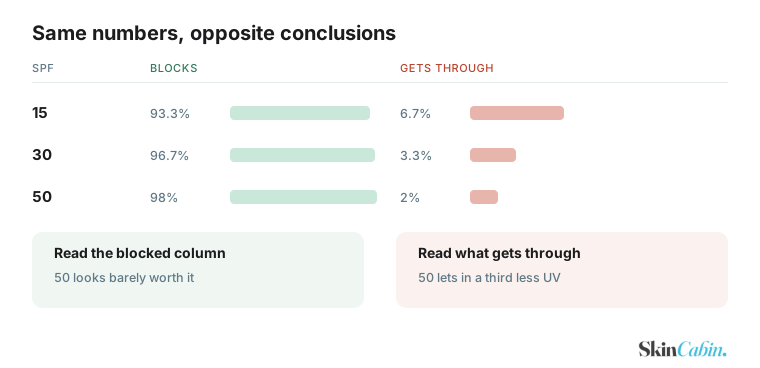 Same numbers. Opposite conclusions.
Read the "blocks" column and 50 looks pointless. 96.7% versus 98%. Barely more than a percentage point.
Read the "gets through" column and it flips. 3.3% versus 2%. That's 40% less UV reaching your skin.
Same numbers. Opposite conclusions. Which one you look at decides what you buy.
Which is right? The second one. What matters is how much UV reaches your skin, not how much was stopped. Going from SPF 30 to 50 cuts your exposure by roughly a third.
Does that mean SPF 100? Diminishing returns set in, and very high numbers can encourage people to stay out longer, which cancels the benefit. SPF 30 is the sensible floor. SPF 50 is better if you're treating pigmentation or spending real time outdoors.
The half the number doesn't cover
SPF measures UVB only. That's a genuine gap.
UVB burns you. It's what SPF measures, and what the number is about.
UVA goes deeper. It drives pigmentation and ageing, and it passes through cloud and glass. SPF tells you nothing about it.
Which means a high SPF with poor UVA protection is a bad sunscreen — you won't burn, so you'll stay out longer, while the rays that cause pigmentation carry on.
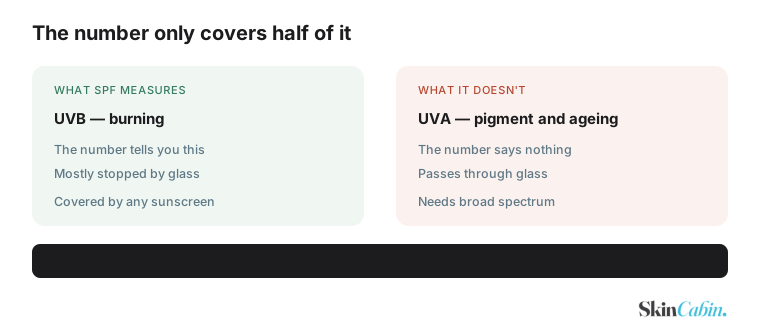 The number covers one of the two.
How to check for UVA protection:
- The words broad spectrum on the front
- A UVA logo in a circle, used in the UK and EU
- PA+++ or PA++++, used in Asian sunscreens. More plus signs is more protection
Never buy a sunscreen without one of those, whatever the SPF says.
What matters more than the number
Three things, all bigger levers than choosing 30 versus 50.
How much you apply
Two finger-lengths for face and neck. A line squeezed along your index and middle fingers. Full detail in how much sunscreen to apply.
That will look like too much. It's the amount SPF is tested at. Apply half and you don't get half the protection. You get a lot less than half.
For your body, roughly a shot glass full.
This is the single biggest gap between the number on the bottle and the protection you actually get.
Whether you reapply
Every two hours outdoors. After swimming or heavy sweating, regardless of how long it's been.
Sunscreen isn't a coating that stays put. It rubs off, sweats off, and degrades.
Whether you wear it at all
Daily beats occasional, by a wide margin. Most sun exposure isn't beach days. It's walking to work, sitting by a window, the school run. Five minutes here and there, for forty years.
A sunscreen you wear every day at SPF 30 protects you far more than an SPF 50 you save for holidays.
Does SPF work differently on darker skin?
The number works the same. What changes is the context.
More melanin gives some natural protection — very roughly equivalent to a low SPF. Some, not enough. Fuller picture in sunscreen for darker skin tones.
Darker skin still burns, still gets sun damage, and still gets skin cancer. Skin cancer in darker skin is less common but more often found late, which makes the outcomes worse.
And UVA matters more, not less. Pigmentation and melasma are more common on deeper skin tones, and UVA drives both. So broad spectrum protection is arguably more important, not less.
The practical problem is that many mineral sunscreens leave a grey cast. That's a formulation issue, not a reason to skip it. Tinted mineral sunscreens and modern chemical formulas both solve it.
Water resistance
There's no such thing as waterproof sunscreen. The labels are specific.
Water resistant — tested to hold up for 40 minutes in water. Very water resistant — 80 minutes.
After that, reapply. And reapply after towel-drying regardless of how long you were in, because towels remove more than water does.
Common myths
"SPF 30 means 30 minutes." No. It's a relative measure, not a duration.
"I don't need it on cloudy days." Cloud stops some UVB. It barely touches UVA.
"I don't need it indoors." UVA passes through glass. If you sit near a window, you're getting it.
"Dark skin doesn't need sunscreen." It does. Less burning, still damage, still cancer risk, and more pigmentation.
We go through the rest — vitamin D, chemical filters, makeup with SPF, waterproof claims — in sunscreen myths.
Quick recap
- SPF measures protection from burning rays only
- It isn't minutes
- The percentages are accurate and misleading — read what gets through, not what's blocked
- SPF 30 lets through 3.3%, SPF 50 lets through 2%. That's a third less
- SPF says nothing about UVA. Look for broad spectrum, a UVA logo, or PA+++
- How much you apply matters more than the number
- Two finger-lengths for face and neck. Most people use a third of that
- Reapply every two hours outdoors
- Every skin tone burns and can get skin cancer
Frequently asked questions
What does SPF actually mean? Sun Protection Factor. A lab measure of how much longer your skin takes to redden with sunscreen on, compared with bare skin. It covers burning rays only.
Does SPF 30 mean 30 minutes of protection? No. It's a relative measure, not a time. Reapply every two hours outdoors regardless of the number.
Is SPF 50 much better than SPF 30? It lets through 2% of UV instead of 3.3% — about a third less. That's more meaningful than the "98% versus 97%" framing suggests.
Do I need SPF higher than 50? Rarely. Returns diminish, and very high numbers can encourage people to stay out longer.
What does SPF not protect against? UVA, unless the product is broad spectrum. UVA drives pigmentation and ageing and passes through glass.
How do I know a sunscreen covers UVA? Look for broad spectrum, a UVA logo in a circle, or PA+++ and above.
How much sunscreen should I use? Two finger-lengths for face and neck. About a shot glass for your body.
How often should I reapply? Every two hours outdoors, and after swimming, sweating or towel-drying.
Do I need sunscreen on cloudy days? Yes. Cloud blocks some burning rays and very little UVA.
Does darker skin need sunscreen? Yes. More melanin gives some protection, nowhere near enough. And UVA drives the pigmentation that deeper skin tones are more prone to.
Is waterproof sunscreen a thing? No. Water resistant means 40 minutes, very water resistant means 80. Reapply after that.
Every sunscreen on SkinCabin is scored on its ingredients rather than its marketing. Find products →
If you're using sunscreen to treat pigmentation, see sunscreen for pigmentation.