How Much Sunscreen Should You Apply?
In short
Two finger-lengths for your face and neck. A line of sunscreen squeezed along your index and middle fingers, from base to tip.
About a shot glass for your whole body. Roughly 30ml.
That will look like more than you expect. It's the amount SPF is tested at, and most people use about a third of it.
Using half doesn't give you half the protection. It gives you considerably less.
Why the amount matters more than the number
The SPF on the bottle is measured in a lab at a fixed thickness — 2mg of sunscreen per square centimetre of skin.
Apply less than that and you don't get the SPF on the label. You get something lower, and the drop is steeper than you'd guess.
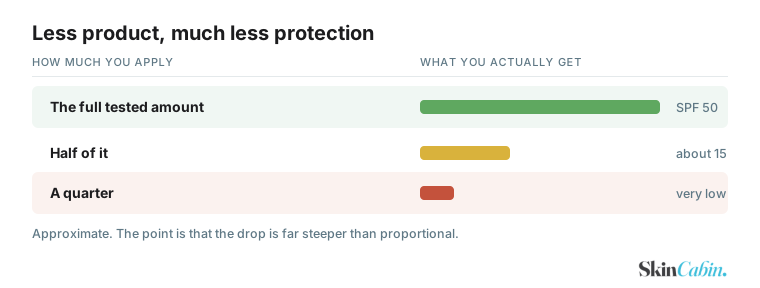 The drop is steeper than proportional.
Roughly what happens:
- Apply the full amount → you get the SPF on the bottle
- Apply half → protection drops to somewhere around a third of the label figure
- Apply a quarter → you're into single-digit territory whatever the bottle says
Which means an SPF 50 applied thinly can protect you less than an SPF 30 applied properly.
The practical conclusion. Stop agonising over 30 versus 50. Put more on.
More on what the number measures in what does SPF mean.
How to measure it
Three methods. Use whichever you'll actually do.
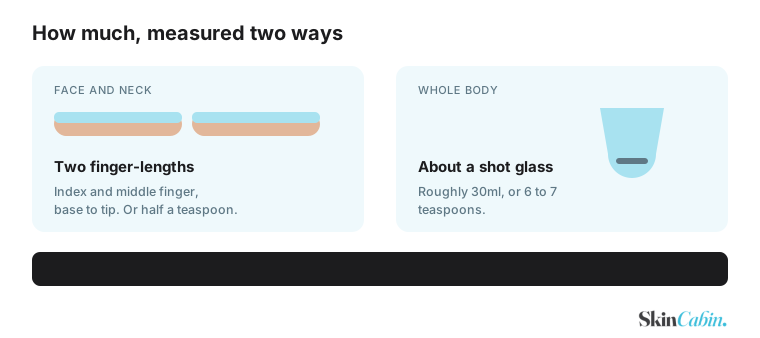 Two ways to measure the same thing.
Two finger-lengths
Squeeze a line of sunscreen along your index finger, from the base to the tip. Then the same on your middle finger.
That's face and neck. Both fingers, not one.
Why it works. It's proportional — bigger hands generally go with a bigger face. And you always have your fingers with you.
If you're only doing your face, one finger-length is roughly right. Don't skip the neck, though. It shows sun damage as clearly as anywhere.
The teaspoon method
Half a teaspoon for face and neck. About 2.5ml.
A teaspoon for each arm, and for the chest and stomach.
Two teaspoons for each leg, and for the back.
Roughly 6 to 7 teaspoons for a whole adult body — about a shot glass.
The blob count
For faces, some people find this easier.
Three fingertip-sized blobs. One for each cheek and jaw, one for forehead, one for nose, chin and around the eyes.
Rough, and better than a smear.
Where people don't put enough
Even people who use the right total amount miss areas.
The most commonly missed:
- Ears, and behind them
- Hairline and parting
- Sides and back of the neck
- Under the jaw and chin
- Eyelids and under the eyes
- Upper lip
- Backs of hands
- Tops of feet
The reflection problem. Under the chin, under the nose and under the eyebrows all catch light bouncing off water, sand and snow. People burn there and can't work out why.
Lips. Skin cancer on the lower lip is more common than people realise. Use an SPF lip balm, and reapply it more often than you think — you eat and drink it off.
Parting. If you have one, it burns. A hat is easier than sunscreen on your scalp.
Applying it properly
Before you get dressed is easier for body sunscreen. You'll cover the edges properly rather than working around clothing.
Pat or press, don't rub thin. Rubbing spreads the same amount over more area, which is the opposite of what you want.
Don't mix it into your moisturiser. Diluting it reduces the protection, and it's impossible to know by how much.
Wait two minutes before makeup, or it pills.
Chemical sunscreens need about 15 to 20 minutes to settle before sun exposure. Mineral ones work immediately.
Reapplying
Every two hours outdoors, and after swimming, sweating or towelling.
Full amount each time, in theory. In practice most people manage less, and less is still worth doing.
Over makeup: a powder, stick or cushion SPF. None matches a proper application, and all beat nothing.
Full detail in how long does SPF 50 last.
Common mistakes
Using a pea-sized amount on the face. That's a moisturiser dose. Sunscreen needs several times more.
Mixing sunscreen into moisturiser. Dilutes it by an unknown amount.
Relying on SPF in makeup. You'd need far more foundation than anyone wears.
Rubbing until it disappears. If there's no trace at all, you may have used too little. A slight sheen for a minute or two is normal.
Only doing the face. Neck, chest and hands show sun damage as clearly, and get treated far less.
Assuming a higher SPF makes up for using less. It doesn't. Amount beats number.
Frequently asked questions
How much sunscreen should I use on my face? Two finger-lengths for face and neck, or about half a teaspoon. It will look like too much.
How much for my whole body? Roughly a shot glass — about 30ml, or 6 to 7 teaspoons.
What is the two-finger rule? A line of sunscreen along your index and middle fingers, base to tip. That's your face and neck.
What happens if I use less? You get less protection than the label says, and the drop is steeper than proportional. Half the amount gives you well under half the protection.
Is SPF 50 applied thinly better than SPF 30 applied properly? No. Amount matters more than the number. A well-applied SPF 30 beats a thin SPF 50.
Can I mix sunscreen into my moisturiser? No. It dilutes the protection by an amount you can't measure.
Do I need to wait after applying? Chemical sunscreens need about 15 to 20 minutes before sun exposure. Mineral ones work straight away. Wait two minutes before makeup either way.
Where do people miss most? Ears, hairline, sides of the neck, under the chin, eyelids, upper lip, backs of hands and tops of feet.
Do I need sunscreen on my lips? Yes. Lower-lip skin cancer is more common than people expect. Use an SPF lip balm and reapply often.
How do I know if I've used enough? It should be visible for a minute or two before it settles. If it vanishes instantly, you probably used too little.
Every sunscreen on SkinCabin is scored on its ingredients rather than its marketing. Find products →
For what the number means, see what does SPF mean.